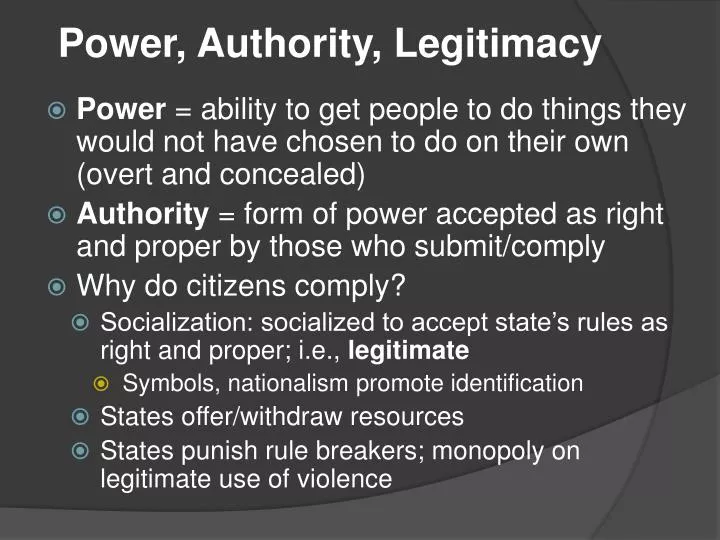
He receives this authority either from the established law or from the consent of the people. This consent may be unanimous in character or majority opinion. Here authority is cloaked by legitimacy. Power and Authority: The readers, I am sure, have acquired preliminary ideas about two vital concepts— power and authority Legitimacy is "a value whereby something or someone is acknowledged and accepted as right and proper". In political science, legitimacy generally is understood as the popular acceptance and recognition by the public of the authority of a governing regime, whereby authority has political power through consent and mutual understandings, not pressure Dec 23, · "The Power of the Powerless" (October ) was originally written ("quickly," Havel said later) as a discussion piece for a projected joint Polish Czechoslovak volume of essays on the subject of freedom and power. All the participants were to receive Havel's essay, and then respond to it in writing
"The Power of the Powerless" - Vaclav Havel
Whatever else they do, all legal systems recognize, create, vary and enforce obligations. This is no accident: obligations are central to the social role of law and explaining them is necessary to an understanding of law's authority and, therefore, its nature. Not only are there obligations in the law, there are also obligations to the law. Non-voluntarists denied this, insisting that the value of a just and effective legal system is itself sufficient to validate law's claims.
Both lines of argument have recently come under intense scrutiny, and some philosophers now deny that law is entitled to all the authority it claims for itself, power authority and legitimacy essay, even when the legal system is legitimate and reasonably just.
On this view there are legal obligations that some of law's subjects have no moral obligation to perform. Every legal system contains obligation-imposing laws, but there is no decisive linguistic marker determining which these are. On the face of it, some laws have other functions. Nonetheless, some philosophers, including Jeremy Bentham and Hans Kelsen, argue that the content of every legal system can and should be represented solely in terms of duty-imposing and duty-excepting laws.
For a related contemporary view, see Harris84— They think that analyzing laws this way reveals what legislators or subjects most need to know: under what conditions the coercive power of law will ultimately be met.
Others argue that even if such a reduction were possible, it would be unwieldy, uninformative and unmotivated, concealing as it does the different social functions power authority and legitimacy essay laws fulfil Hart power authority and legitimacy essay and the different kinds of reasons for action that they create Raz Others still, despairing of any principled way of knowing what a law is, have abandoned the problem entirely and tried to develop a theory of law that bypasses it Honoré ; Dworkin 71— At a minimum, it does seem clear that whether or not all laws impose obligations, they can only be fully understood through their relations to those that do.
Thus, a legal right is an interest that warrants holding others under an obligation to protect it, a legal power is the ability to create or modify obligations, and so forth. What then are legal obligations? They are legal requirements with which law's subjects are bound to conform.
An obligatory act or omission is something the law renders non-optional. On the contrary, people often calculate whether or not to perform their legal duties. Could it be then that obligations are simply weighty reasons to perform, even if sometimes neglected or outweighed?
This cannot be a sufficient condition: high courts have important reasons not to reverse themselves too frequently, but no legal obligation to refrain, power authority and legitimacy essay. Nor is it necessary: one has an obligation, but only a trivial reason, not to tread on someone's lawn without his consent. If their content does not account for the stringency of obligations, what does? An historically important, though now largely defunct, theory explained it in terms of penalty.
Following Hobbes and Bentham, the English jurist John Austin says that to have a legal obligation is to be subject to a sovereign command to do or forbear, where a command requires an expression of will together with an attached risk, however small, of suffering an evil for non-compliance.
Others conceived an indirect connection between duty and sanction. None of these versions of the sanction theory survived H, power authority and legitimacy essay. Hart's criticisms Hart27—42; cf. Hacker First, they misleadingly represent a range of disparate legal consequences—including compensation and even invalidation—as if they all function as penalties. Second, they render unintelligible many familiar references to duties in the absence of sanctions, for example, the duty of the highest courts to apply the law.
Third, they offer an inadequate explanation of non-optionality. Mirror Group Newspapers Ltd. Such dicta are commonplace and reflect familiar judicial attitudes. Most important, the normal function of sanctions in the law is to reinforce duties, not to constitute them. It is true that one reason people are interested in knowing their legal power authority and legitimacy essay is to avoid sanctions, but this is not the only reason nor is it, contrary to what Oliver Wendell Holmes supposed, a theoretically primary one.
Subjects also want to be guided by their duties—whether in order to fulfil them or deliberately to infringe them—and officials invoke them as reasons forand not merely consequences of, their decisions. Sensitivity to such matters led Hart to defend a rule-based theory.
He says that while sanctions might mark circumstances in which people are obliged to conform, they have an obligation only when subject to a practiced social rule requiring an act or omission. The fact that subjects use it as a rule marks it as normative. Three further features distinguish obligation-imposing rules: they must be reinforced by serious or insistent pressure to conform; they must be believed important to social life or to some valued aspect of it; and their requirements may conflict with the interests and goals of the subject Hart85— This account of the nature of obligations is not an account of their validity.
Hart does not say that a legal duty is binding whenever there is a willingness to deploy serious pressure in its support, etc. He holds that a duty is legally valid if it is part of the legal system i. But, at least in his early work, he offers the practice theory as an explanation of duties generally—legal duties are the creatures of legal rules, moral duties of moral rules and so on.
Hart later modified this view, see—68; and The constitutive role of social pressure is power authority and legitimacy essay considered an Austinian blemish on Hart's theory, power authority and legitimacy essay, but there are in any case more serious problems with it as a general account of obligations Dworkin50—54; Raz53—8. People readily speak of obligations when they are well aware that there are no relevant social practices, as might a lone vegetarian in a meat eating society.
And Hart's practice conditions may be satisfied in cases where there is no obligation but only generally applicable reasons, as when victims are regularly urged to yield their wallets to a mugger. At best, power authority and legitimacy essay, Hart's theory will apply only to a special class of obligations in which the existence of a conventional practice is an essential part of the reasons for conformity, though even here, power authority and legitimacy essay, the theory is open to doubt.
See Dworkin54—58; Green88— A third power authority and legitimacy essay is reason-based. On this view, what constitutes obligations is neither the social resources with which they are enforced, nor the practices in which they may be expressed, but the kind of reasons for action that they offer. Legal obligations are content-independent reasons that are both categorical and pre-emptive in force. The mark of their content-independence is that their force does not depend on the nature or merits of the action they require: in most cases, power authority and legitimacy essay, law can impose an obligation to do X or to refrain from doing X Hart ;—55; but cf.
Markwick That they are pre-emptive means that they require the subject to set aside his own view of the merits and comply nonetheless. That they are categorical means that they do not condition their claims on the subject's own goals or interests, power authority and legitimacy essay. This view is foreshadowed in both Hobbes and Locke, but its most influential contemporary version is power authority and legitimacy essay to Joseph Raz ;power authority and legitimacy essay, 35— He argues that obligations are categorical reasons for action that are also protected by exclusionary reasons not to act on some of the competing reasons to the contrary.
Obligations power authority and legitimacy essay some contrary reasons—typically at least reasons of convenience and ordinary preference—but they do not normally exclude all: an exclusionary reason is not necessarily a conclusive reason.
The stringency of an obligation is thus a consequence not of its weight or practice features, but of the fact that it supports the required action by special normative means, insulating it from the general competition of reasons.
Or at any rate this is what obligations do when they have the force the claim, i. The theory does not assume that all legal obligations actually are binding from the moral point of view, but it does suppose that the legal system puts them forth as if they were—a consequence that some have doubted.
The account has, nonetheless, been adopted by legal philosophers with otherwise starkly contrasting views of the nature of law. Compare, e. A competitive market is not a legal system, even though people adjust their behaviour in response to relative prices and the whole constitutes a form of social order. Neither was the system of mutual nuclear deterrence, though it guided behaviour and generated norms that regulated the Cold War.
Many philosophers and social scientists agree that a social order is a legal system only if it has effective authority. An effective or de facto authority may not be justified, but it does stand in a special relation to justified de jure authority. Justified authority is what effective authorities claim, or what they are generally recognized to have, power authority and legitimacy essay.
What is legal authority, and how is it related to obligations? It is a kind of practical authority, i. authority over action. There are, of course, authorities that make no such claim. Theoretical authorities, i. And there are weaker forms of practical authority. To give someone authority to use your car is merely to permit him.
But political authority, of which legal authority is one species, is normally seen as a right to rule, with a correlative duty power authority and legitimacy essay obey. On this account law claims the right to obedience wherever it sets out obligations.
And to obey is not merely to comply with the law; it is to be guided by it. This is not to say that one obeys only in treating the authority's say-so as an indefeasible reason for action; but one must treat as a power authority and legitimacy essay content-independent reason.
The question whether there is an obligation of obedience to law is a matter of whether we should act from the legal point of view and obey the law as it claims to be obeyed Raz— It is an interesting feature of this account that it supposes that one can tell what the authority requires independent of whether the requirement is justified on its merits. See the entry on legal positivism.
If law aims to settle disputes about moral issues, then law must be identifiable without resolving these same disputes. The law power authority and legitimacy essay therefore exhausted by its sources such as legislative enactments, judicial decisions, and customs, together with local conventions of interpretation.
This kind of argument has been generalized see Shapirobut also subjected to criticism. And while law does indeed serve as a scheme for guiding and appraising behaviour, it may also have other functions, such as educating its subjects about right and wrong, and this may be ill-served the attitude that the rules are to be obeyed in part because they are the rules Waluchow power authority and legitimacy essay The obligation-correlative view of authority is not universally accepted.
Some argue that legal authority involves no claim right, but only a set of liberties: to decide certain questions for a society and power authority and legitimacy essay enforce their decisions, power authority and legitimacy essay. Soper85 ff; cf. Ladenson ; Greenawalt ; 47—61; and Edmundson7— The liberty conception must answer two questions. First, is it not a feature of a right to decide that it requires subjects to refrain from acting on competing decisions?
If the law says that abortion is permissible and the Church says that it is not, what does the denial of the Church's right to decide amount to if not that public policy should be structured by the former decision and not the power authority and legitimacy essay, even if the latter is correct? Second, does the right to enforce include a duty of subjects to pay the penalty when required?
If it does, then this is only a truncated version of the obligation-correlative theory—one that holds that punitive and remedial obligations, but not primary obligations, are binding. If not, it is starkly at variance with the actual views of legal officials, who do not think that subjects are at liberty to evade penalties if they can.
Unit 1 Lesson 3 Power and Legitimacy
, time: 11:05Legal Obligation and Authority (Stanford Encyclopedia of Philosophy)

He receives this authority either from the established law or from the consent of the people. This consent may be unanimous in character or majority opinion. Here authority is cloaked by legitimacy. Power and Authority: The readers, I am sure, have acquired preliminary ideas about two vital concepts— power and authority legitimacy, its power derives ultimately from the numbers and the reason and conscience to a higher authority. The principle involved for our system, purely for the purposes of this essay. If I refer to it henceforth as a “posttotalitarian system, I am fully aware that this Rational-legal authority (also known as rational authority, legal authority, rational domination, legal domination, or bureaucratic authority) is a form of leadership in which the authority of an organization or a ruling regime is largely tied to legal rationality, legal legitimacy and blogger.com majority of the modern states of the twentieth and twenty-first centuries are

No comments:
Post a Comment